

-
 admin
- 30th October 2026
 admin
Electric Forklift Operator Training Required Before Operation
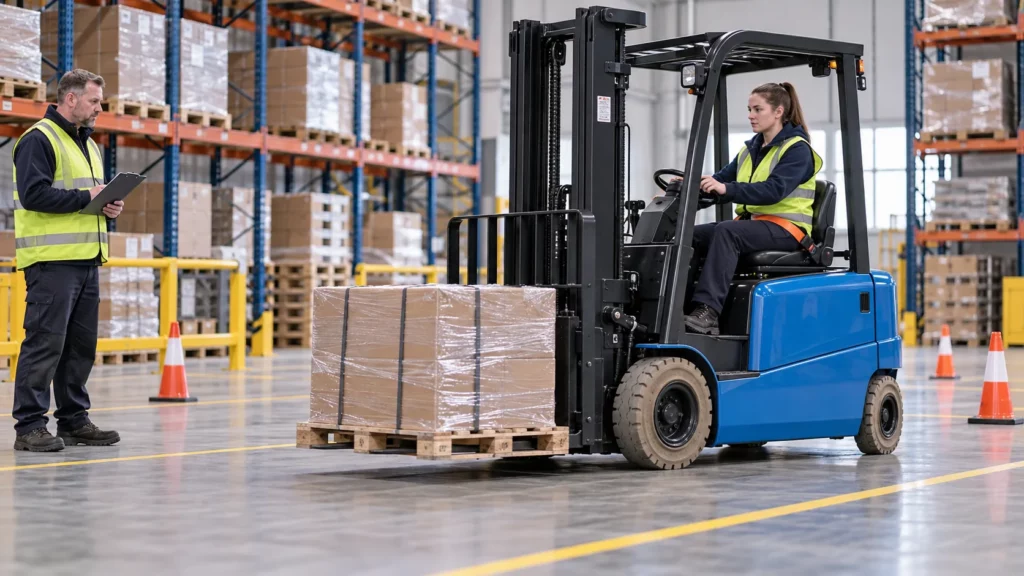
Electric forklift operator training must be completed before an employee operates independently in a U.S. workplace. The employer must ensure that the person has received formal instruction, practical training, and an evaluation of performance in the workplace. Training must fit the Forklift type, attachments, loads, and site. An online lesson or a wallet card alone does not establish workplace competence. The OSHA powered industrialForklift training rule places responsibility on the employer to train, evaluate, and authorize each operator. Other countries, states, and sites may impose additional requirements, so the employer should verify the rules that apply to the location.
The Three Required Parts of Forklift Operator Training
A complete forklift operator training program combines three elements. Formal instruction explains how the Forklift works, the hazards involved, and the rules for the workplace. Practical training lets the trainee watch demonstrations and perform supervised exercises. The final workplace evaluation confirms that the person can operate the assigned Forklift safely under real job conditions.
Trainees may operate a Forklift during training only under the direct supervision of a person qualified to train and evaluate operators, and only where the exercise does not endanger anyone. Production work should not be used as an informal substitute for supervised practice. Authorization should follow successful completion of all three elements.
Formal Instruction Must Cover the Forklift and the Workplace
Truck-related instruction should address the controls, motor operation, steering, visibility, capacity, stability, forks, attachments, operating limits, inspections, warnings, and the operator manual. The trainee must understand how a forklift differs from an automobile, including rear-end swing, a small stability area, load-center effects, and the change in handling when a load is raised or off center.
Workplace topics should cover the surfaces, loads, stacking tasks, pedestrians, narrow aisles, ramps, docks, trailers, restricted areas, and any unusual environmental hazards at the site. A general course may introduce these subjects, but the employer still has to connect them to the actual route and work rules.
Electric Specific Training Topics
Electric forklift operator training must address the assigned power system. Battery chemistry, charger, connectors, restraints, displays, braking behavior, and emergency shutdown features may differ by model. Use the manual and capacity information for the exact configuration, and review the RELILIFT electric forklift range without assuming that every Forklift responds in the same way.
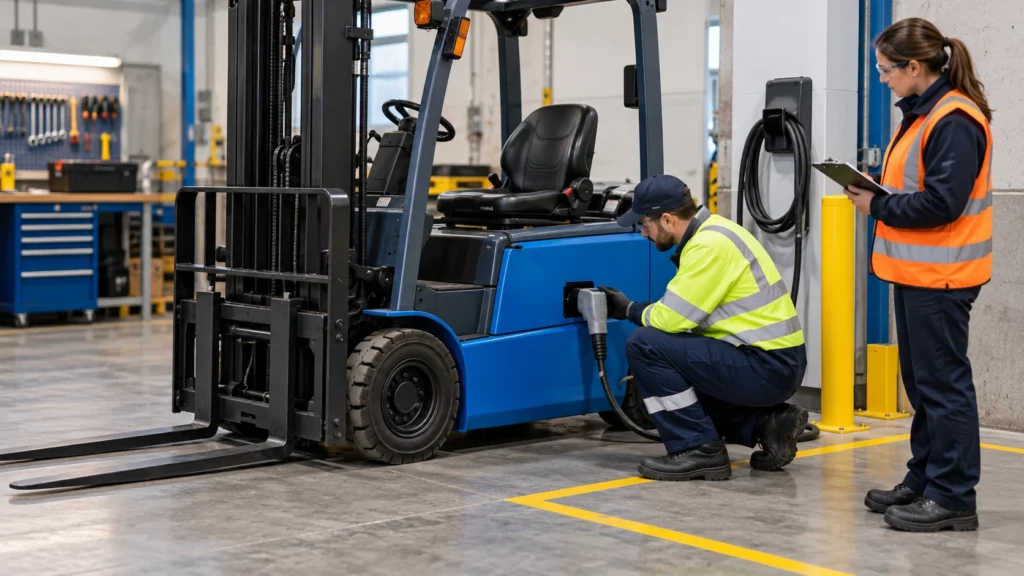
- Recognize battery, cable, connector, restraint, and charger conditions that require theForklift to be removed from service.
- Follow the approved charging procedure, parking position, ventilation rules, and personal protective equipment requirements for the installed battery system.
- Understand battery-state indicators, diagnostic messages, regenerative braking behavior if fitted, and the location and purpose of the emergency disconnect.
- Know which inspections or battery tasks operators may perform and which repairs belong to authorized maintenance personnel.
Hands On Practice Before Authorization
Practical training should begin in a controlled area and progress from basic control to realistic load handling. The trainee should demonstrate mounting and restraint use, startup, steering, braking, forward and reverse travel, turning, parking, fork positioning, lifting, lowering, tilting, stacking, un-stacking, and safe travel with a load. Exercises should include the Forklift’s normal attachments and the site’s common pallet or container types.
The trainee must also complete the employer’s pre-use inspection and defect-reporting process. A model-specific checklist should address the battery, forks, mast, tires, controls, warnings, capacity plate, and route. RELILIFT’s electric forklift safety checklist can support that discussion, but the employer must adapt the checklist to the exact Forklift and local procedure.
The Workplace Evaluation
The evaluation should take place on the assigned Forklift in the workplace, or under conditions that accurately reproduce the job. The evaluator should observe travel, turns, intersections, pedestrian controls, load pickup, load placement, stacking, parking, charging-area access, and any ramps, docks, trailers, or narrow aisles the operator will use. A written quiz cannot replace this performance observation.
If performance is not safe or consistent, the evaluator should stop the exercise, provide additional training on the relevant task, and repeat the evaluation. Authorization should identify the Forklift types and work conditions the operator is permitted to handle rather than imply unlimited permission for every powered industrial Forklift.
Trainer Qualifications and Employer Records
Training and evaluation must be conducted by people who have the knowledge, training, and experience to teach operators and judge competence. The employer certifies completion and records the operator’s name, training date, evaluation date, and the identity of the trainer or evaluator. Supplier familiarization can help explain a model, but it does not transfer the employer’s duty to evaluate the employee in the workplace.
Refresher Training and Reevaluation
Refresher training is required when an operator is observed driving unsafely, is involved in an accident or near miss, receives an evaluation showing unsafe performance, is assigned a different Forklift type, or faces a workplace change that can affect safe operation. Under the U.S. rule, each operator’s performance must also be evaluated at least once every three years. A site may set a shorter interval.
Authorization Checklist Before the First Shift
- Confirm that formal instruction covers the assigned electricForklift, attachments, loads, and workplace hazards.
- Complete supervised exercises using the controls, inspections, load-handling tasks, travel paths, and charging procedure that the job requires.
- Pass a workplace performance evaluation conducted by a qualified evaluator.
- Record the required training and evaluation details, then issue authorization for the definedForklift type and work area.
- Provide the operator manual, site rules, inspection form, defect-reporting route, and emergency procedure before independent operation.
Equipment Information That Supports Training
Employers should obtain the manual, capacity information, battery and charger instructions, attachment limits, warning-device details, and maintenance contacts for the purchased configuration. RELILIFT describes global technical support for troubleshooting, maintenance, and operator-safety guidance; the buyer should confirm the exact materials and response terms included for the model and destination.
Conclusion
An operator is ready only after instruction, supervised practice, and a successful workplace evaluation. Electric-specific battery and control topics belong inside that process, not in a separate shortcut. Employers should define the authorized Forklift and work area, keep training records, and trigger refresher training whenever performance, equipment, or conditions change.
Frequently Asked Questions
Can Online Training Alone Authorize an Electric Forklift Operator
No. Online instruction can satisfy part of the formal component, but practical training and an evaluation of workplace performance are also required before independent operation in a U.S. workplace.
Does Previous Forklift Certification Transfer to a New Employer
Previous training may reduce duplication when it remains appropriate to the Forklift and conditions, but the new employer must evaluate the operator and confirm competence for its workplace.
Does an Electric Forklift Require Less Training Than a Fuel Powered Forklift
No. The power source changes some hazards and procedures, but operators still need training on capacity, stability, visibility, maneuvering, loads, inspections, and workplace conditions.
How Often Is Refresher Training Needed
Refresher training follows specific triggers such as unsafe operation, an incident, a failed evaluation, a different Forklift type, or changed workplace conditions. U.S. employers must evaluate performance at least once every three years.
Request Configuration Information for Training
For a model-specific training review, send the Forklift model, battery and charger type, attachments, load details, operating area, and destination requirements to contact RELILIFT’s technical team. Use the resulting product information as an input to the employer’s training program and workplace evaluation.


 Related





Excellent Service Each and Every Time