

-
 admin
- 22nd October 2026
 admin
When to Replace an Electric Forklift and Plan Its Life Cycle

Replace an electric forklift when its safety, reliability, capacity, or cost no longer supports the work, not simply when it reaches a calendar age or hour reading. A sound decision combines inspection findings, repair history, downtime, battery condition, parts support, operator feedback, and the truck’s ability to meet current loads and routes. Life-cycle planning begins at purchase and sets review points before a failure forces an emergency decision. RELILIFT’s electric forklift range can be evaluated against the next duty profile when an existing unit approaches replacement.
Do Not Use Age or Operating Hours Alone
Operating hours help compare utilization, but they do not reveal how the truck earned those hours. Repeated high lifts, impacts, ramps, rough floors, heat, cold, moisture, dust, overloading, poor charging practice, and irregular maintenance can age two identical trucks very differently. A lightly used truck can also become uneconomic if parts are difficult to obtain or if its capacity and layout no longer fit the operation. Use age and hours as triggers for a deeper review, not as automatic replacement rules.
How to Decide When to Replace an Electric Forklift
A defensible review uses four evidence groups: safe condition, operational fit, reliability, and total cost. The decision should be documented at truck level so the fleet team can distinguish a repairable component problem from a declining asset.
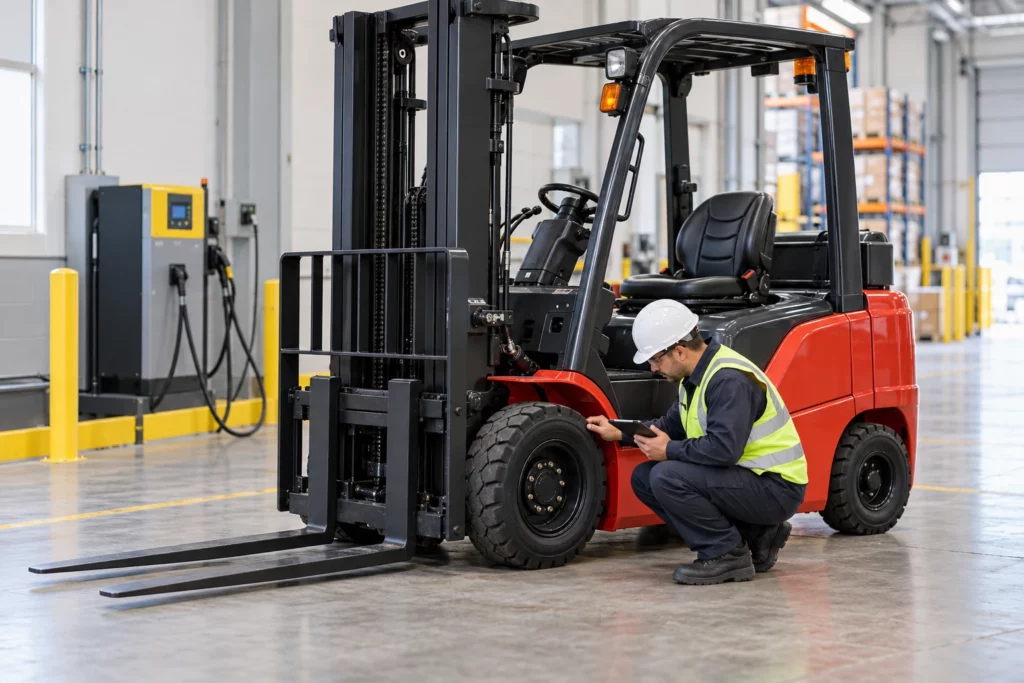
Safety and Structural Condition
Safety overrides economic analysis. Cracks, damaged forks or mast components, brake or steering defects, electrical damage, restraint problems, leaks, or other conditions that affect safe operation require immediate control and qualified evaluation. The OSHA powered industrial truck standard states that a truck found defective or unsafe must be taken out of service until it is restored to safe operating condition. Replacement becomes appropriate when safe restoration is infeasible, unsupported, or disproportionate to the remaining value and expected duty.
Operational Fit
A mechanically serviceable truck may still be obsolete for its assignment. Review maximum load, load center, residual capacity at height, attachment, aisle clearance, lift speed, travel distance, ramp and floor conditions, environmental exposure, and required throughput. Changes in racking, product mix, packaging, shifts, charging windows, or facility layout can make the original configuration inefficient or unsuitable. Use the warehouse selection guide to rebuild the application specification before choosing a successor.
Reliability and Downtime
Track failures by system, operating hour, shift, and cause. A rising number of unscheduled stops, repeated faults after repair, slower parts response, or increasing rental coverage indicates more than a single invoice. Record lost production, blocked docks, labor waiting time, overtime, recovery transport, and service administration. A replacement case becomes stronger when the truck no longer provides predictable availability and the operation cannot absorb the interruptions.
Maintenance Cost and Economic Performance
Compare repair spending with the value of reliable work the truck still delivers. Use a rolling period long enough to avoid overreacting to one repair. Separate planned maintenance, tires, damage, battery work, major components, and downtime. Then compare the forecast cost of keeping the truck with the annualized cost and expected productivity of a replacement. The electric forklift cost planning guide provides a framework for acquisition, energy, maintenance, downtime, and replacement reserves.
Battery Condition Versus Truck Condition
Do not replace a complete forklift solely because the battery has weakened. Measure usable runtime, voltage behavior, charging history, temperature events, balance or maintenance records, and charger compatibility using the battery supplier’s procedure. If the chassis, mast, controls, and drive system remain suitable, a battery or charger replacement may extend useful service. Conversely, a healthy battery should not justify keeping a truck with structural, safety, parts-support, or application-fit problems. Evaluate the truck, battery, and charger as related assets with different replacement cycles.
Create a Life Cycle Plan Before Problems Escalate
A practical life-cycle plan assigns data, review points, and funding across the asset’s service life. It does not attempt to predict one exact retirement date.
- At commissioning, record the application, configuration, battery and charger identifiers, warranty terms, expected utilization, service intervals, and acceptance results.
- During normal operation, capture hours, inspections, scheduled service, repair cause, cost, downtime, damage, battery performance, operator reports, and changes to the route or load.
- At each annual or high-utilization review, reassess safe condition, capacity, reliability, energy performance, parts support, and whether the truck still fits the operation.
- Before the economic replacement window, obtain a condition report, forecast major work, estimate resale or disposal value, confirm lead time, and reserve capital so the purchase is planned rather than urgent.
Set Clear Review Triggers
The fleet policy should identify events that start a formal replacement review. Useful triggers include a safety-critical finding, a major component estimate, repeated unscheduled downtime, maintenance cost rising beyond the internal threshold, battery replacement coinciding with other major work, loss of parts or service support, insufficient capacity, or a facility change that the truck cannot serve. These triggers start analysis; they do not predetermine the answer. RELILIFT’s after-sales support program can be discussed when buyers evaluate service requirements for a replacement configuration.
Use a Repair Replace or Reassign Decision
A review should allow three outcomes. Repair the truck when safe restoration is practical, the application remains suitable, and forecast ownership cost is acceptable. Replace it when safety, reliability, capability, or combined life-cycle cost is no longer defensible. Reassign it when the truck is safe and serviceable but a lighter-duty application better matches its remaining capability. Reassignment should use a new documented application review rather than an informal transfer.
Plan the Transition to the Next Truck
Avoid ordering a duplicate of an old specification without checking the present workflow. Measure the current load, height, aisle, floor, ramp, dock, travel, shift, and charging requirements. Decide whether attachments, tires, mast, battery chemistry, charger, electrical supply, operator training, maintenance tools, spare parts, and data interfaces will change. Build in delivery, commissioning, familiarization, inspection, and disposal or reassignment time. A planned overlap can protect throughput while the new truck is accepted and the old unit is retired.
Conclusion
Electric forklift replacement timing should be evidence-based. Safety comes first; operational fit, reliability, maintenance trend, battery condition, parts support, and downtime complete the decision. A life-cycle plan turns those signals into scheduled reviews and capital preparation, reducing the risk of keeping an uneconomic truck or replacing a repairable one too early.
Frequently Asked Questions
How many years should an electric forklift last
There is no universal service life. Hours, load severity, environment, maintenance, charging, damage, parts support, and application changes matter more than calendar age alone. Use condition and cost records to set the review.
Should a forklift be replaced when the battery fails
Not automatically. Test the battery and charger, then evaluate the truck’s structural condition, controls, drive system, mast, safety, suitability, and remaining economic value. The battery and truck may have different replacement cycles.
What is the strongest sign that replacement is due
An unresolved safety issue is the strongest immediate signal. For an otherwise safe truck, repeated downtime combined with rising cost and poor application fit usually provides a stronger case than age or hours alone.
How often should a fleet review replacement timing
Review at least through the organization’s regular annual capital and safety process, and sooner after a major fault, application change, battery decision, parts-support issue, or sustained rise in downtime.
To request a lifecycle fit check, send RELILIFT the current model, hours, load and lift data, route, shifts, repair history, battery details, charging window, attachments, and quantity.


 Related





Excellent Service Each and Every Time